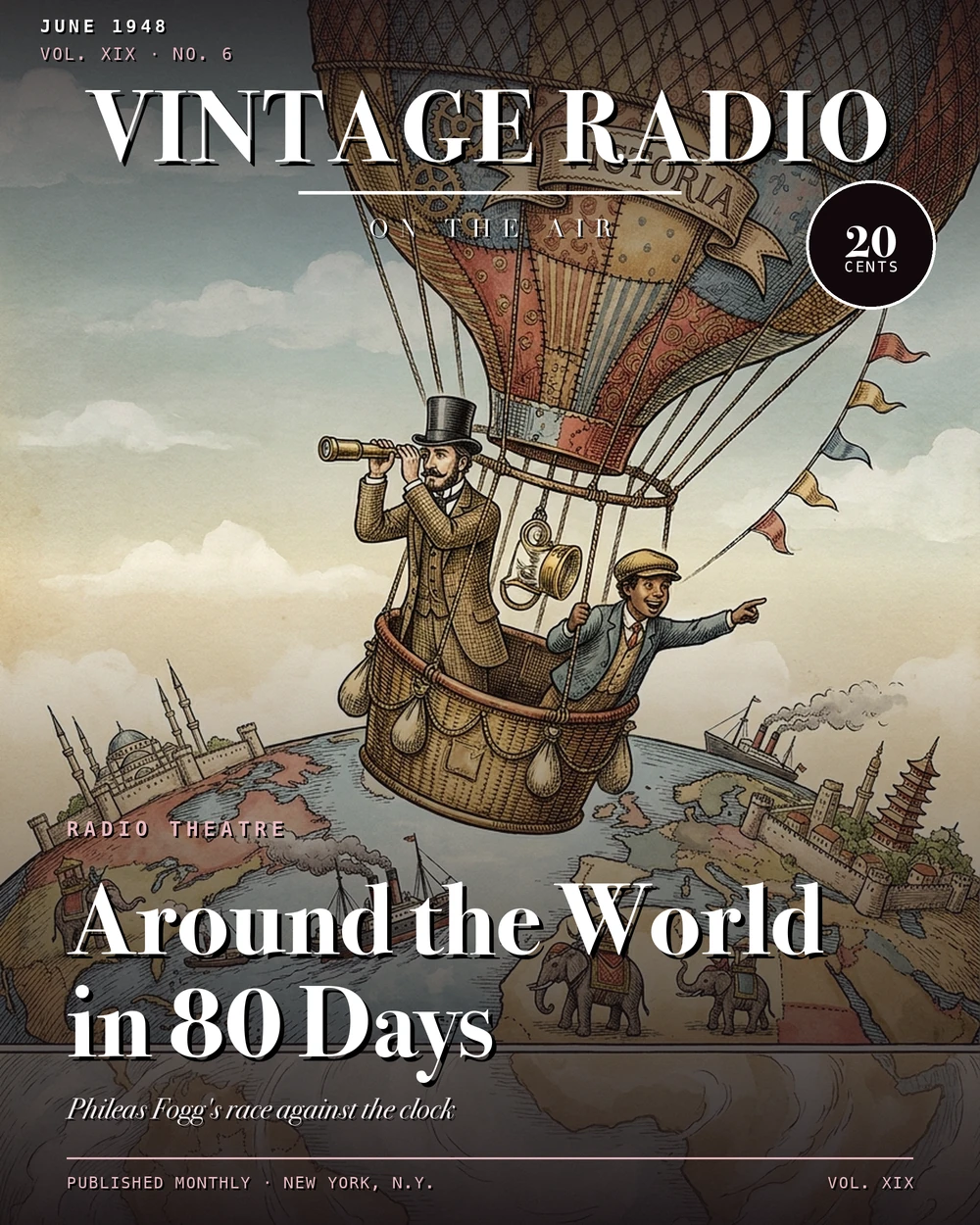
Around the World in 80 Days
The Wager That Started Everything
Jules Verne's novel had been thrilling readers since it ran in serial form in the French newspaper Le Temps in 1872 — and the premise was irresistible from the start. Phileas Fogg, a wealthy and methodical English gentleman, bets £20,000 — half his entire fortune — with fellow members of London's Reform Club that he can circle the globe in eighty days. He and his French servant Passepartout leave London almost immediately, traveling by every available means: trains, steamships, and at one memorable stretch, an elephant. The wager has a fixed deadline and a fixed destination: Fogg must return to the Reform Club by 8:45 p.m. on December 21 or lose everything.
That ticking-clock structure is what made Verne's story such natural material for radio serialization. Each leg of the journey brings a new setting, a new complication, and a new reason to tune in next week. The two central characters could not be more different — the cool, precise Fogg and the excitable, impulsive Passepartout — and that contrast carries the drama across twenty-four episodes without wearing out its welcome.
The Story the Series Tells
The journey takes Fogg and Passepartout east from London through Suez, India, Hong Kong, Yokohama, San Francisco, and across the American continent before the final sprint back across the Atlantic. Along the way, they encounter a situation that becomes one of the serial's key moral turning points: in India, they rescue Aouda, the daughter of a wealthy Bombay merchant of the Parsee community. She is well-educated and thoroughly Europeanized — far from the vague "exotic princess" that looser adaptations sometimes present — and she travels with Fogg and Passepartout for the remainder of the journey.
Tracking the travelers throughout is Detective Fix, a Scotland Yard detective dispatched from London after a £55,000 robbery of the Bank of England. The robber's description resembled Fogg, and Fogg's sudden departure from London shortly after the theft made him the prime suspect. Fix first encounters the travelers at Suez and shadows them across the world, working to delay Fogg long enough to have him arrested on British soil. In Hong Kong, Fix drugs Passepartout in an opium den to prevent him from telling Fogg that their ship, the Carnatic, is leaving early — which is precisely why Passepartout ends up boarding the Carnatic alone, the situation dramatized in Episode 14.
The episode titles in the second half of the catalog trace the final push with some precision: a squall on the way to Yokohama, a paddle-wheel steamer to San Francisco, the transcontinental Pacific Railroad, then east through the American interior — "Old and New Adversaries," "Another Strange Vehicle," "The Hudson and The Atlantic" — before Fogg lands at Liverpool Pier and makes his way home. The final two episodes, "A Saddened Fogg Arrives Home" and "The Reform Club again," build to the conclusion that the novel made famous: Passepartout, having crossed the International Date Line traveling eastward, realizes the travelers gained a full day without knowing it. Fogg, who believed he had lost the wager, arrives at the Reform Club just in time. Episode 24 is titled, with satisfying precision, "Eighty Days Precisely."
How Radio Handled This Material
An adventure serial with this many locations faces a real production challenge: every few episodes, the soundscape has to suggest a different part of the world. The episode titles alone signal the variety — from Pacific squalls to American railroad cars to the Hudson River approach to New York. Radio drama achieves that kind of geographic sweep almost entirely through writing, voice performance, and sound effects, which puts a premium on scripts that are specific enough to land the listener somewhere real without stopping the plot to describe the scenery.
The twenty-four episode run is long enough to develop the Fix subplot properly — his appearances become increasingly desperate as the journey nears its end and British jurisdiction gets farther away — and to let the relationship between Fogg and Passepartout carry real weight. The servant-and-employer dynamic was central to Verne's comedy as much as his adventure, and a serial format can develop that interplay across episodes in ways a single broadcast cannot.
The catalog's episode 13, set during a squall on the way to Yokohama, and episode 15, aboard a paddle-wheel steamer to San Francisco, represent the mid-journey stretch that keeps both the geography and the stakes in motion before the American episodes accelerate into the home stretch.
The Mercury Theatre Connection
The most celebrated radio treatment of this story came before this serial. On October 23, 1938 — one week before the famous War of the Worlds broadcast — Orson Welles and the Mercury Theatre on the Air presented Around the World in 80 Days on CBS. It was the sixteenth episode of that series. Welles played Fogg; Edgar Barrier played Passepartout; Ray Collins took the role of Fix; and Arlene Francis played Madam Aouda. Bernard Herrmann composed and conducted the original music.
Welles returned to the material in 1946 for the Mercury Summer Theatre, sponsored by Pabst Blue Ribbon on CBS, where Around the World in 80 Days served as the first episode of that short-lived series. At the time, Welles was also working on a stage production of the same story. The coincidence underlines how naturally the Verne novel lent itself to performance — Welles kept finding new reasons to revisit it across different formats and different decades.
The 24-episode serial in this catalog draws on the same source novel that produced those Mercury Theatre broadcasts and, later, the 1956 film starring David Niven as Fogg, Cantinflas as Passepartout, and Shirley MacLaine as Aouda — a production that won five Academy Awards including Best Picture. The story proved durable enough to attract a 2010 BBC Radio 7 adaptation as well, with Leslie Phillips as Fogg and Jim Broadbent as Sergeant Fix, written by Terry James and directed by Janet Whittaker.
Where It Sits in the Adventure Catalog
In the old-time radio landscape, Around the World in 80 Days belongs alongside adventure serials like The Man Called X, Captain Midnight, and Challenge of the Yukon — programs built around travel, danger, and a protagonist with a clear mission. What distinguishes the Verne adaptation from those contemporaries is the source material itself: a nineteenth-century novel that was already a classic when radio was invented, with a plot architecture so clean that it survives translation across formats almost intact.
The Reform Club wager gives every episode a clock to run against. Fix gives the journey a human antagonist whose motivations are entirely reasonable — he genuinely believes Fogg is a thief — which makes him a more interesting obstacle than a straightforward villain. Aouda's presence in the second half changes the emotional register of the journey without displacing the adventure. And Passepartout's accidental discovery at the end, that eastward travel across the date line had given them a day they didn't know they had, is the kind of plot resolution that rewards an audience who has followed the serial all the way through. It is a trick that works best the first time, and radio, with its episodic structure and attentive listeners, was an ideal format for delivering it.